
Roughly 80% of the dogs I’ve trained or boarded have struggled with leash pulling. It’s one of the most common issues owners face — and one of the easiest to understand once you know why it happens.
Leash pulling usually isn’t defiance. It’s enthusiasm. Dogs naturally walk faster than we do, and being outside is their version of Disneyland. With a bit of structure (and the right tools), you can teach your dog to walk calmly at your side — no yelling, no pain, no frustration.
Why Most Dogs Pull on the Leash
Dogs pull because they’re excited, curious, or under-exercised. Some simply want to explore at their own pace — and that pace is usually much faster than ours. Others pull because they’ve learned that it works; every time they tug forward and reach the next smell, the pulling is rewarded.
The most traditional fix is strict discipline — requiring the dog to walk slightly behind you at all times. While this can be effective, many owners struggle to maintain it consistently. That’s where the front-pull harness becomes an invaluable training aid.
Give the Dog Their “Pull Time” First
Before any leash training session, it helps to give your dog a short window to get the excitement out of their system. I call this the “pull zone.”
For me, it’s usually about two blocks — the length of our street. Sometimes I’ll even jog those two blocks with the dog. After that, the energy is out, and the rest of the walk is calm and controlled.
Think of it as a simple rule:
The first two blocks are the dog’s. The rest of the walk is yours.
Why I Retired the Gentle Leader
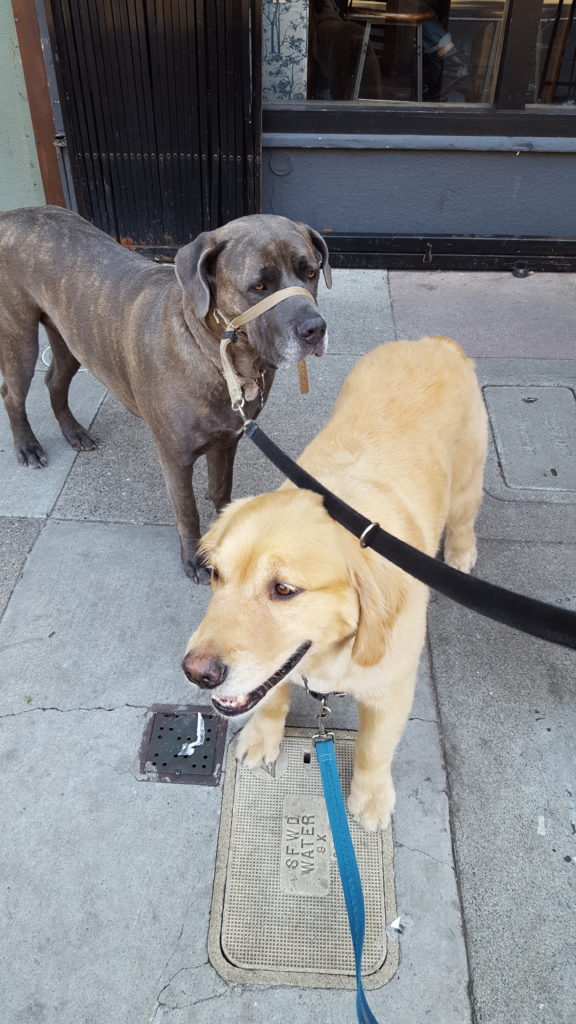
My first attempt at managing pulling was with the Gentle Leader — a head halter that loops around the dog’s snout. It’s often mistaken for a muzzle, and while it can be effective, it’s not for every dog.
I first used it on Dragon, a 130-pound Cane Corso with a love for forward motion. The Gentle Leader worked — she stopped dragging me — but she absolutely hated it. She rubbed her snout on people, the ground, and even walls to get it off. It became clear that the pressure on her face was uncomfortable, even painful.
The Gentle Leader stopped the pulling, but at the cost of her comfort — and that’s not a fair trade.
The Front-Pull Harness: A Better, More Humane Option
Enter the front-pull harness, one of the most effective and humane tools I’ve used for leash training. Instead of applying pressure to the dog’s face, it attaches at the chest. When the dog pulls forward, the harness gently turns them sideways, throwing them slightly off balance.
The result? They quickly learn that pulling doesn’t work. There’s no pain, no choking, no frustration — just a natural redirection.
In Dragon’s case, this small change made a world of difference. She stopped pulling within minutes and began walking comfortably at a human pace. The harness did the work; all I had to do was guide.
My Favorite Front-Pull Harnesses
There are many options out there, but after years of testing, here’s what I’ve found:
🐾 The Easy Walk Harness
Popular, lightweight, and simple to use. However, in my experience, it tends to shift around on the dog’s body, which reduces its effectiveness.
🐾 The Mighty Paw Multi-Purpose Harness (Top Pick)
This harness offers exceptional design and stability. It features both front and rear attachment points, a sturdy back handle (great for extra control or breaking up a scuffle), and it doubles as a car harness for travel safety.
You can usually find it for under $30 on Mighty Paw’s website or Amazon — a fantastic value for a high-quality piece of gear.
🐾 The Freedom Harness
This newer design uses dual leash attachments (front and back) for added control. It’s particularly useful for strong pullers or dogs that tend to lunge suddenly.
Classic Collar
If you have a dog that pulls regardless of what tool you use, then you may actually be better off using the classic collar. To utilize this method, when the dog begins to pull give a quick tug and start walking in the opposite direction. Repeat, until the dog gets so fed up and confused that they stop pulling all together. If they start back up again later in the walk, do it again – quick tug and a 180 degree change in direction. If done correctly this will work 99.999% of the time.
Final Thoughts
Leash pulling doesn’t have to be a lifelong battle. Whether you choose to work on traditional discipline, use a modern front-pull harness, or the classic collar consistency is what matters most.
The right tool can transform your walks from frustrating to relaxing — for both you and your dog. Remember: the goal isn’t domination; it’s communication and control. With patience, structure, and a good harness, you can enjoy calm, confident walks every day.